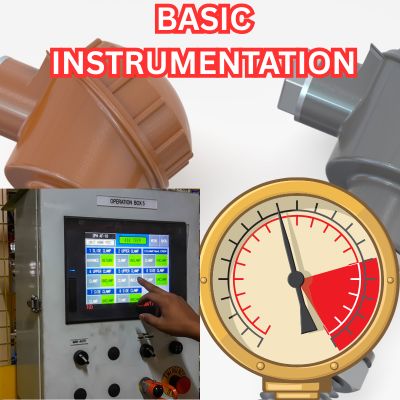
What is Basic Instrumentation Full Guide 2025 Introduction:
What is Basic Instrumentation Full Guide 2025 Instrumentation is the backbone of every industry — from manufacturing and power plants to automation and healthcare. It involves the measurement, monitoring, and control of physical quantities like pressure, temperature, flow, level, and more.
What is Basic Instrumentation Full Guide 2025 Understanding basic instrumentation is essential for anyone working in electronics, electrical engineering, process industries, or even home automation. Whether you’re a student, technician, or aspiring engineer, learning how instruments work, what sensors are used, and how data is interpreted will provide a strong foundation for advanced studies and career growth.
What is Basic Instrumentation Full Guide 2025 In this blog post, we’ll cover all the essential concepts of basic instrumentation, with real-world examples, key terms, and practical uses to help you grasp how modern systems measure and control physical variables. Instrumentation is the science of measurement and control of process variables in engineering systems. It is essential in industries like oil and gas, power generation, pharmaceuticals, and manufacturing. If you’ve ever wondered how a temperature is measured precisely or how a control system keeps a machine running efficiently, you’re thinking about instrumentation.
This comprehensive FAQ guide answers all your questions related to basic instrumentation, providing clear, practical, and foundational knowledge for students, professionals, and beginners.
What is the Basic Instrumentation Full Guide 2025 Overview:
What is Basic Instrumentation Full Guide 2025 word professional guide will cover the following:
📏 What is instrumentation?
🧭 Importance and objectives of instrumentation
⚙️ Key physical parameters measured: temperature, pressure, flow, level, etc.
📟 Types of measuring instruments: analog vs digital
🎯 Accuracy, precision, range, and calibration explained
🔌 Sensors and transducers: how they work and types
📶 Signal conditioning and conversion
🔁 Basic control systems: open-loop and closed-loop
🏭 Applications in industries: oil & gas, power plants, automation
🧪 Instrumentation in research and healthcare
🔧 Common tools and devices used
📚 Instrumentation terms and abbreviations
📈 Career scope in instrumentation field
What is Basic Instrumentation Full Guide 2025 Conclusion:
What is Basic Instrumentation Full Guide 2025 Instrumentation is not just about measuring — it’s about control, accuracy, and efficiency. From simple thermometers to complex PLC-based systems in industries, instrumentation plays a vital role in every step of the process.
What is Basic Instrumentation Full Guide 2025 Understanding the principles of measurement, sensor types, calibration, and control systems gives you an edge in technical fields and prepares you for a future in automation, robotics, or process control. With industries rapidly adopting IoT and smart monitoring systems, the demand for skilled instrumentation professionals continues to grow.
The first step to being proficient in one of the most important engineering fields of the twenty-first century is understanding fundamental instrumentation, which this guide has given a thorough review of.Instrumentation is the heart of all modern industrial and automation systems. From a simple thermometer to complex PLC-controlled processes, it all starts with measuring, monitoring, and controlling real-world variables.
What is Basic Instrumentation Full Guide 2025 This FAQ guide has covered everything you need to know about basic instrumentation—from sensors and control systems to calibration, accuracy, and career scope. Whether you’re a student or a working professional, understanding these fundamentals will help you step confidently into the world of automation and control engineering.
Full FAQ Guide Basic Instrumentation 2025 Basic Instrumentation Concepts:
- What is instrumentation in simple words?
A) Instrumentation refers to the tools, devices, and systems used to measure and control physical quantities such as temperature, pressure, flow, level, and speed in a system.
- Why is instrumentation important?
A) Instrumentation helps:
Monitor system performance
Ensure safety in industrial processes
Maintain quality control
Optimize energy usage and productivity
- What is a process variable in instrumentation?
A) A process variable is a measurable condition of a system such as:
Temperature
Pressure
Flow
Level
Humidity These are monitored and controlled for smooth operations.
- What are the four main functions of instrumentation?
A) 1.Measurement
2.Indication
3.Control
4.Recording
These functions ensure proper feedback and automation in systems.
- What is the difference between measurement and instrumentation?
A) Measurement is determining the value of a quantity.
Instrumentation involves using devices and systems to perform the measurement and control.
✅ Types of Measuring Instruments
- What are analog and digital instruments?
A) Analog Instruments show readings on a scale (e.g., voltmeter with a needle).
Digital Instruments display readings numerically (e.g., digital multimeter).
- What is a sensor in instrumentation?
A) A sensor is an apparatus that senses and reacts to a physical stimuli, such as pressure or heat, and transforms it into an electrical signal for control or measurement.
- What is a transducer?
A) One type of energy is transformed into another by a transducer. While not all transducers are sensors, all sensors are transducers.
For instance, sound waves are transformed into electrical impulses via a microphone.
- What are common types of sensors used?
A) Temperature sensor (e.g., thermocouple)
Pressure sensor (e.g., piezoelectric sensor)
Level sensor (e.g., float switch)
Flow sensor (e.g., turbine meter)
Proximity sensor (e.g., capacitive, inductive)
- What is the role of signal conditioning in instrumentation?
A) Signal conditioning modifies sensor signals to a form suitable for processing. It includes:
Amplification
Filtering
Isolation
Conversion (Analog-to-Digital)
✅ Key Measurement Parameters
- What is accuracy in instrumentation?
A) The degree to which a measured value resembles the true value is known as accuracy. For example, if the actual temperature is 100°C and the device shows 99.9°C, it is highly accurate.
- What is precision?
A) Precision is the ability to reproduce the same result repeatedly, even if it’s not accurate. High precision doesn’t always mean high accuracy.
- What is sensitivity?
A) Sensitivity refers to how much the output of an instrument changes with a small change in the input. Higher sensitivity means a more responsive instrument.
- What is calibration?
A) Calibration is the process of adjusting an instrument to ensure its readings are correct by comparing it with a known standard.
- What is zero error?
A) Zero error occurs when the instrument shows a reading even though the measured quantity is zero. It must be corrected for accurate measurements.
- What is range and span in instrumentation?
A) Range: The minimum to maximum values the instrument can measure (e.g., 0–100°C).
Span: The difference between the maximum and minimum (e.g., 100°C – 0°C = 100°C span).
✅ Control Systems and Loops
- What is a control system?
A) A control system monitors and adjusts process variables to desired levels automatically, often using sensors, controllers, and actuators.
- What are open-loop and closed-loop systems?
A) Open-loop: No feedback; output is not compared with the input (e.g., microwave timer).
Closed-loop: Feedback is used to maintain desired output (e.g., thermostat controlling room temperature).
- What is PID control?
A) PID stands for Proportional-Integral-Derivative. It’s a feedback control method used to maintain process variables like temperature or pressure at set levels with precision.
- What are actuators?
A) Actuators convert control signals into physical action. Examples:
Electric motors
Pneumatic cylinders
Solenoid valves
✅ Instrumentation Devices and Tools
- What is a pressure gauge?
A) It’s an instrument used to measure fluid or gas pressure in a system. Common types include Bourdon tube and diaphragm gauges.
- What is a thermocouple?
A) A thermocouple is a sensor that measures temperature using the voltage generated between two different metals when heated.
- What is a flow meter?
A) A device used to measure the flow rate of liquids or gases. Types:
Turbine
Ultrasonic
Electromagnetic
Orifice
- What is a data logger?
A) A digital device that records data over time from sensors, often used in testing, monitoring, or research.
- What tools are used in instrumentation?
A) Multimeter
Clamp meter
Oscilloscope
Calibrators
Loop testers
Pressure/vacuum pump
✅ Applications of Instrumentation
- Where is instrumentation used?
A) Power plants (monitor temperature, speed)
Chemical and pharma industries (level, flow control)
Automotive sector (engine sensors)
HVAC systems (climate control)
Oil & gas (pipeline monitoring)
Hospitals (ECG, ventilators)
- What is the role of instrumentation in automation?
A) Instrumentation enables automation by measuring process conditions and adjusting control elements (like valves, motors) through control systems.
- How does instrumentation improve safety?
A) It monitors critical conditions like pressure or temperature to prevent failures, alerts operators, and can trigger shutdowns in emergencies.
- How does instrumentation support quality control?
A) It ensures that measurements stay within required tolerances during production, reducing errors and improving consistency.
- What is the role of SCADA in instrumentation?
A) SCADA (Supervisory Control and Data Acquisition) is a system used to collect, analyze, and control data in real-time from multiple instruments across facilities.
✅ Common Instrumentation Terms
- What is lag in measurement?
A) Lag is the amount of time that passes between an instrument’s corresponding output and a change in input.. Too much lag can reduce system performance.
- What is hysteresis?
A) The difference in output when the input rises or falls is known as hysteresis. It affects the accuracy and repeatability of some sensors.
- What is drift in instruments?
A) Drift is a slow change in the instrument’s output over time without any change in the input. Regular calibration helps correct it.
- What is dead zone or dead band?
A) It is the range of changes in input that have no effect on output.. Common in mechanical instruments like pressure gauges.
- What is linearity in instrumentation?
A) When an instrument is linear, its output is directly proportionate to its input across the whole measurement range.
✅ Learning & Career in Instrumentation
- Is instrumentation part of electrical or electronics engineering?
A) It overlaps both fields. Often taught as Instrumentation & Control Engineering (ICE) or Electronics and Instrumentation Engineering (EIE).
- What are some instrumentation courses available?
A) Diploma in Instrumentation
B.Tech in Instrumentation Engineering
Certified Automation Professional (CAP)
Online courses on Coursera, NPTEL, Udemy
- What career options exist in instrumentation?
A) Instrumentation Engineer
Process Control Technician
SCADA Operator
Calibration Engineer
Automation Specialist
- What industries hire instrumentation professionals?
A) Oil & Gas
Power Generation
Food & Pharma
Aerospace
Automotive
Water Treatment
- How do I start learning instrumentation?
A) Start with the basics:
Learn physics and electronics
Practice with basic sensors
Study control systems and circuits
Use simulation tools (e.g., Proteus, LabVIEW)
Take certifications and hands-on internships